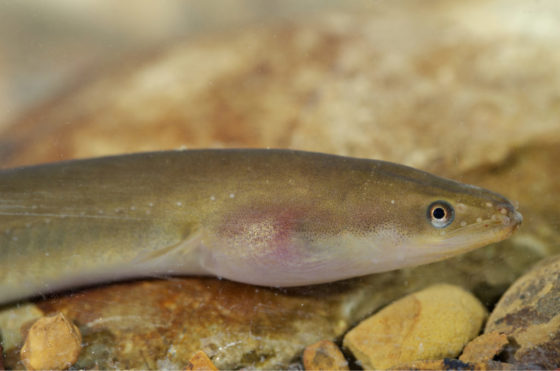
The Commission is proposing a roll-over of this year’s provisions for the annual eel fishing closures, which will be adopted at the Fisheries Council later this week. For a critically endangered population with a zero catch advice since 2021 for all life stages, including catches for aquaculture and restocking, the current provision as well as the proposals are in breach of the CFP objectives on sustainable fishing and should be considered the bare minimum. We call on all Member States to urgently take further action.
The annual eel fishing closures have been in place since 2018 and the aim is to protect eel migration to secure a faster recovery for this critically endangered population.
The eel provision for most Union waters is included in Proposal for a COUNCIL REGULATION fixing for 2026, 2027 and 2028 the fishing opportunities for certain fish stocks, applicable in Union waters and, for Union fishing vessels, in certain non-Union waters (COM(2025)662), under Article 13. Note that brackets in the text have now been removed after the release of the ICES advice for 2026 on 4 November.
Essentially, the proposal is to maintain the existing measures in all relevant EU waters – in the Atlantic, the Baltic Sea and the Mediterranean. The fishing closures applies to all EU marine and brackish waters, including estuaries, coastal lagoons and transitional waters. Commercial fishing for all life stages of European eel shall be prohibited for at least six consecutive or non-consecutive months between 1 April 2026 and 31 March 2027, and shall cover the main migration period or periods, including the respective peak, of European eel at the respective life stage in the Member State concerned.
Members States and fishers shall also undertake all reasonable efforts to eliminate any bycatch of European eel. Recreational fisheries of European eel at all life stages shall be prohibited in EU waters.
The closure period or periods may differ between Member States or within a Member State from one fishing area to another in order to take account of the geographical and temporal migration patterns.
In order to ensure the effective protection of silver eel migrating from the Baltic Sea to the North Sea, the coastal Member States of ICES subarea 3 – Denmark, Germany, Estonia, Latvia, Lithuania, Poland, Finland and Sweden – shall agree on coordinated effective closure periods for silver eel. If they are unable to reach agreement by 1 April 2026, the closure period shall be 15 September 2026 to 15 March 2027.
Like the current regulation (EU 2025/202), the proposal includes a number of derogations that apply under specific conditions, allowing to fishing continue during part of the eel migration periods:
- All coastal Member States may allow fishing activities targeting eels below [glass eels] or above 12 cm to continue for up to 30 days during the main migration period, provided that they determine an additional closure of an equivalent period of time during the main migration period, or just before or after it.
- In addition, Member States may allow fishing for eels <12 cm exclusively for restocking for up to an additional 50 days during the main migration period, resulting in a total derogation of up to 80 days in glass eel fisheries. This is also conditional on implementation of an additional closure of an equivalent number of days during the main migration period, or just before or after it. This derogation mainly benefits France, as over 95% of the glass eel landings are taken in French waters.
After Russia announced that they plan to increase eel restocking and catches in the Vistula Lagoon, an in-year amendment to the current regulation was agreed earlier this year, supporting a new Polish trap-and-transport programme through a new derogation. This allows Poland to fish for eels of 12 cm or more, when they are migrating from Union waters to their spawning grounds in the Sargasso Sea [downstream migration] for up to an additional 50 days during the main migration period, provided that:
- the eels only route to marine waters takes them through non-Union brackish waters;
- the catches comply with the minimum conservation reference size of 35 cm;
- any sexually mature eel that is caught is not harmed and transported without delay to be released in nearby Union marine waters;
- any incidentally caught eel that is not sexually mature is not harmed and immediately released back into the water; and
- the fishing activity is undertaken with the involvement of a national scientific body.
For the Mediterranean, the provision is included in Proposal for a COUNCIL REGULATION fixing the fishing opportunities for certain fish stocks and groups of fish stocks applicable in the Mediterranean and Black Seas for 2026 (COM(2025)509), under Article 4. The proposal is based on the adoption of a long-term management measures for European eel under the General Fisheries Commission for the Mediterranean (Recommendation GFCM/47/2024/1). The Mediterranean measures apply to all waters, including freshwater habitats. It mandates a commercial eel fishing closure from 1 January to 31 March 2026, with an additional three months to be established by each Member State between 1 April–30 November. It sets out further protections for glass eels with a two-month limit on commercial fishing, which is allowed only under certain conditions. The only country currently fishing for glass eel in the Mediterranean is Spain. All recreational fishing for all life stages is prohibited.
Protection of eel migration now full of holes
The focus of the closures is to protect eel migration, but the current regulation and the proposal for 2026 allows Member States to keep the fishery open for 30 days during the peak migration period, and in the case of glass eel fisheries – eels < 12 cm – for an additional 50 days, as long as the catch during one of those periods is used for restocking.
The reason initially provided for these exceptions is “the potentially severe socio-economic implications of a full closure of fisheries targeting glass eel and silver eel during the main migration period”.
For a critically endangered population with a zero catch advice since 2021 for all life stages, including catches for aquaculture and restocking, the current provision as well as the proposals are definitely in breach of the CFP objectives on sustainable fishing. As a “category 3 stock”, the precautionary approach should be applied.
We therefore consider the current proposal the bare minimum and call on all coastal Member States to close all fisheries during peak migration in order to support eel recovery and future fisheries, even if it may have socio-economic effects in the short term.
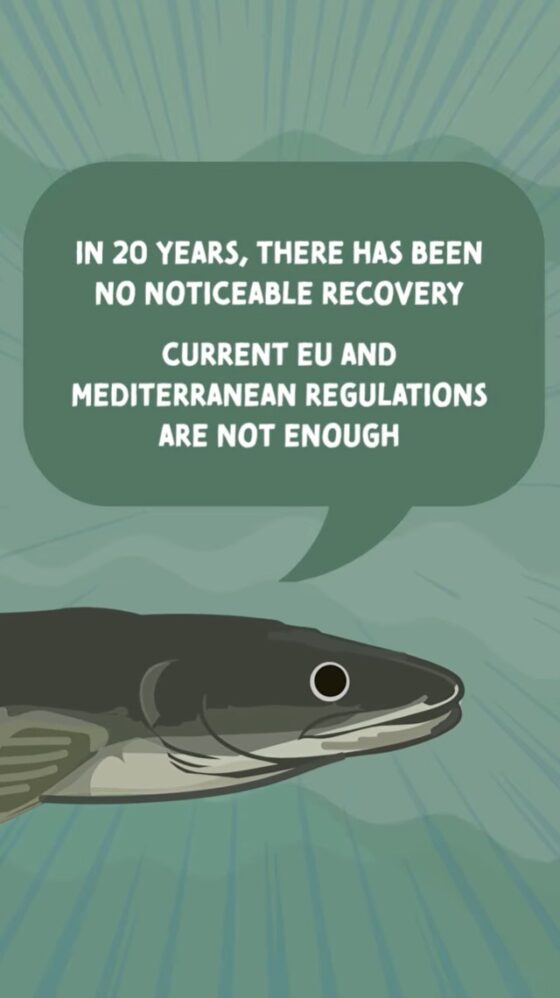
For more information:
Mediterranean and Black Sea fishing opportunities
Other Union waters fishing opportunities
Watch our short animation about eel and eel fishing closures here.