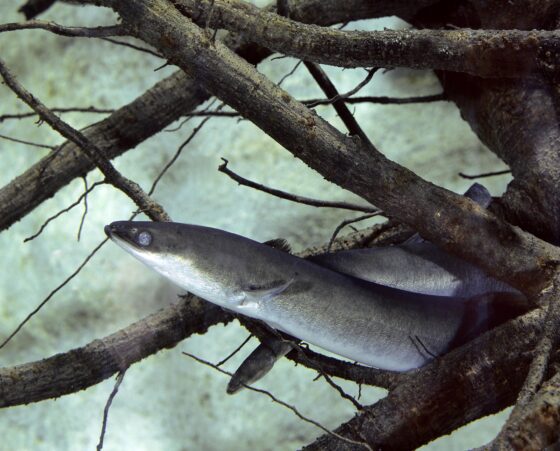
CITES Summit ending today rejected a proposal to list all Anguillid eel species under Appendix II to protect them from illegal and unsustainable trade. The proposal put forward by the EU and Panama was rejected by a large majority including key countries involved in trade, aquaculture and consumption.
European eel (Anguilla anguilla) has been listed as Critically Endangered by the International Union for Nature Conservation (IUCN) since 2008. It was added to Appendix II under the Convention on International Trade in Endangered Species of Wild Fauna and Flora (CITES) in 2007. But it is not the only eel species under threat. Japanese eel (Anguilla japonica) and American eel (Anguilla rostrata) have been listed as Endangered since 2018 and 2020 respectively. All three species have management frameworks in place, but they are generally considered insufficient and populations are not recovering. Increasing market demand, primarily in South East Asia, and escalating prices have created conditions for increased exploitation. Eel farms globally remain entirely dependent on wild-caught glass eels and elvers, and therefore the pressure on wild populations is expected to increase further, affecting other eel populations less well monitored and managed and resulting in substantial illegal trade in all species.
Eels in their early life stages and eel products are almost indistinguishable and species identification requires DNA testing. Therefore, the EU and Panama tabled a proposal to list all Anguillid species under Appendix II, including Japanese eel and American eel, which would qualify in their own right for listing. They argued that listing “is necessary to ensure effective enforcement, minimise the risk of misidentification, and support the implementation of CITES controls for currently listed species”. A listing of all eel species would not have prevented trade in any of the species, but it would have led to greater control of trade in order to ensure it is not threatening the populations.
Sadly, the proposal was rejected at the CITES Conference of Parties in Samarkand, which concludes today. Only Monaco, the United Kingdom and Israel were openly supportive of the proposal, which received support from 35 countries, with 100 countries including Japan, China, USA and Canada opposed. A resolution on eel was agreed, recognising the threat of trade and illegal trade to eel species globally and recommending countries to strengthen existing measures to protect already listed species, i.e. European eel.